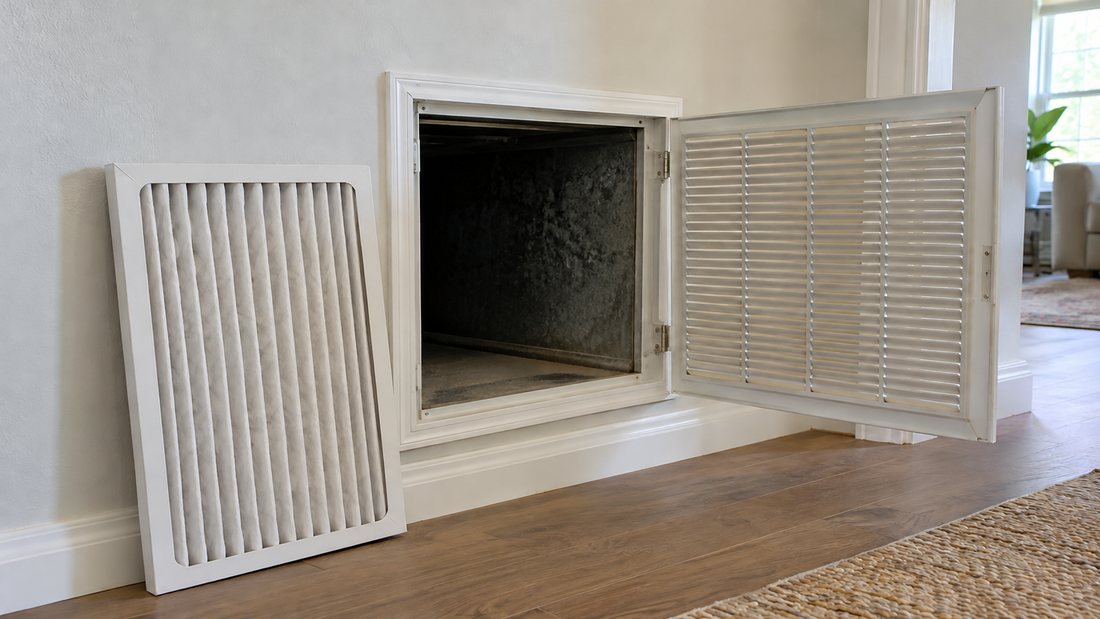
What should I note when there is very little air from the vents?
Identify whether one room or the whole home is affected. Check for furniture covering accessible supply or return grilles. Note recent filter changes, visible ice, and unusual blower noise. Persistent airflow problems need measurements, not a guess based on one vent.
Make a simple room-by-room record
Name the rooms where air feels weaker than it did before. Compare them during the same cooling request, without climbing to a ceiling grille. Separate air that feels weak from air that feels warm; both can occur together, but they are different observations.
Record whether the change was sudden or has been present since you moved in. Mention a recent filter replacement, room renovation, furniture move, or service visit. These are details for the assessment, not proof that any one event caused the problem.
- Is one room affected, several adjacent rooms, or every accessible register?
- Are any return grilles covered by furniture, curtains, or stored items?
- Does the indoor fan sound different, and is ice or water visible without opening anything?
Air needs a path out and a path back
Supply ducts carry cooled air to rooms. Return paths let air go back to the AC. A blocked return grille or a filter that restricts too much air can limit that flow. If the problem stays, ask for airflow tests and a check of the return path.
ENERGY STAR also lists leaky, loose, or kinked ducts as reasons for poor airflow. A warm room does not prove a duct has one of those faults. Much of the duct may be hidden. Ask how it will be checked before a wall or ceiling is opened.
Do not assume that a stronger blower or a denser filter is the answer. The filter and equipment need to be compatible. Ask which measurements show the restriction and how the proposed work will address the affected rooms.
Clear ordinary obstructions, then stop there
Move furniture or curtains away from safely reachable grilles. Keep the normal air paths open; do not cover other returns to force air toward a warm room. Leave internal dampers, blower settings, and duct modifications to the assessment.
If the owner's manual permits routine filter replacement at a location you can safely reach, follow its size, type, and installation instructions. Record the filter label if available. Do not stack filters, remove the filter as an ongoing workaround, or open equipment to find one.
If air remains weak, report the room pattern and arrange service. Ice requires cooling to be switched off. A roof space, crawlspace, or concealed duct route is not a place to enter simply to strengthen the symptom report.
Separate equipment work from duct access
Ask whether the planned service check includes the filter path, indoor fan, and relevant ducts. Request the airflow findings in plain language: where airflow was blocked or lost and which rooms it affects. A plan for duct work should name the section that needs repair.
Before authorizing access through a ceiling or wall, ask who will open and restore the finish and what is included in the price. In a managed building, check who owns that AC unit and duct route. Do not authorize work in common areas without the proper approval.
Explain any bedroom or work area that is especially affected. Ask how the result will be checked after the repair and whether further balancing is proposed. Cleaning, sealing, replacing a duct, and repairing a blower are distinct tasks; the written scope should make the chosen work clear.
Questions about this repair
Should I close other vents to send more air to one room?
Keep normal air paths open and request an airflow check. Closing or covering grilles does not identify the reason the room is under-served.
Does weak airflow mean I need duct cleaning?
That conclusion needs evidence. Ask whether the restriction is at the filter, blower, coil, return path, or duct, and which findings support the proposed work.
Can a new filter make the airflow feel different?
A filter that is too restrictive for the equipment can affect airflow. Follow the equipment manufacturer's specifications and keep the replacement filter details available for the assessment.